
 WhatsApp

What to Do If You Are Pulled Over for DUI in Miami
Seeing police lights behind you can be stressful, especially if an officer suspects alcohol or drug impairment. What you say and do during the stop may become evidence. The safest general approach is to stay calm, avoid arguing, follow lawful directions and avoid volunteering information that could be used against you.
This guide explains general Florida law and the steps that may matter during and after a Miami-Dade DUI stop. It is not a substitute for advice about a specific stop, test request or arrest.
A quick roadside checklist
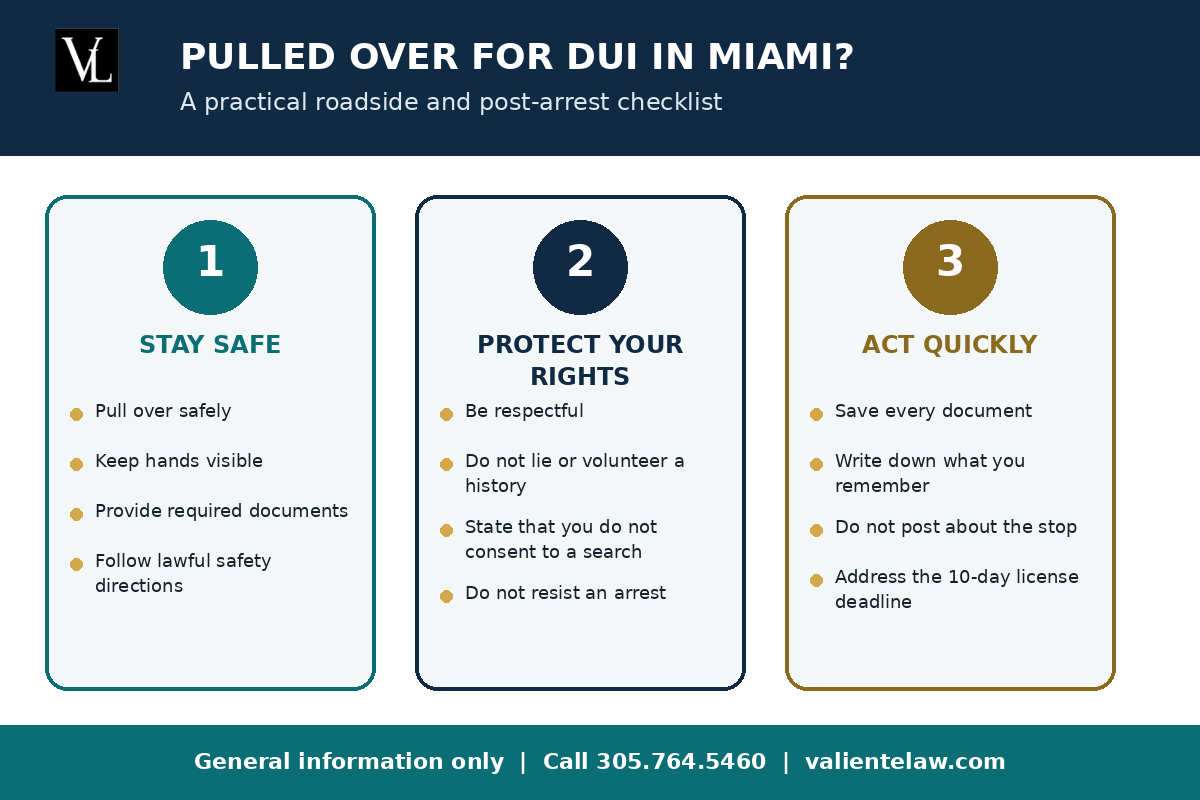
- Pull over safely. Use your turn signal, stop in a safe place, turn off the engine and keep your hands visible.
- Provide the required documents. Be prepared to provide your driver’s license, registration and proof of insurance.
- Follow lawful safety directions. If an officer orders you to step out of the vehicle during a lawful traffic stop, comply. Do not turn the roadside into a legal argument.
- Do not volunteer a drinking history. You can be respectful without explaining where you were, what you drank, what medication you took or how you feel.
- Do not consent to a search merely because an officer asks. You can clearly say, “I do not consent to a search,” while still following lawful orders.
- Do not resist an arrest. If the officer arrests you, remain calm, do not physically resist and ask to speak with a lawyer.
Can an officer make me get out of the car?
Yes, during a lawful traffic stop an officer may order the driver out of the vehicle for safety reasons. That is different from asking for consent to search the vehicle. Follow the exit instruction. If the stop or the officer’s conduct was unlawful, that issue is challenged later through evidence and legal motions, not through resistance on the roadside.
Do I have to answer questions about drinking?
You must provide identifying and driving documents when lawfully required. You do not have to volunteer answers to investigative questions such as:
- “How much did you drink?”
- “Where are you coming from?”
- “When was your last drink?”
- “Are you taking any medication?”
A calm response may be: “I would like to remain silent and speak with a lawyer.” Do not lie. A false statement can create additional problems. Silence and refusal to consent are different from refusing to follow lawful safety commands.
What are field sobriety exercises?
Officers may ask a driver to perform roadside exercises such as the walk-and-turn, one-leg stand or horizontal gaze nystagmus exercise. The officer may use the driver’s movements, balance, instructions, statements and refusal as evidence.
Florida does not treat roadside field sobriety exercises the same way it treats a post-arrest breath or urine test under the implied-consent statute. Even so, declining the exercises is not consequence-free. Florida appellate authority recognizes that a refusal to perform pre-arrest field sobriety tasks may be admitted as evidence in a DUI case. Whether the request, instructions, conditions and refusal were legally significant depends on the facts.
There is no single online answer that is safe for every driver. A lawyer reviewing the stop should examine the body-camera video, road and lighting conditions, footwear, injuries, medical conditions, language issues and the officer’s instructions.
Is a roadside breath test the same as the official breath test?
Not necessarily. A portable roadside screening device and an evidentiary breath test requested after a lawful arrest can involve different legal rules and purposes. Florida’s implied-consent statute ties an evidentiary breath test to a lawful arrest and other statutory conditions.
If an officer requests a breath, urine or blood test, listen carefully to the warnings and ask which test is being requested. Do not assume that refusing is the safer option. The law changed on October 1, 2025, and a qualifying first refusal of a lawful breath or urine test may now create a separate criminal charge as well as a driver-license suspension.
What happens if I refuse a lawful breath or urine test?
Under current Florida law:
- A first qualifying refusal may result in a one-year administrative driver-license suspension.
- A second or subsequent qualifying refusal may result in an 18-month suspension.
- For incidents on or after October 1, 2025, a qualifying first refusal of a lawful breath or urine test may be charged as a second-degree misdemeanor.
- A qualifying second or subsequent refusal may be charged as a first-degree misdemeanor.
- The refusal may be used as evidence in the criminal case.
The precise result depends on the incident date, the test requested, whether the arrest and request were lawful, whether the required warnings were given and the driver’s prior history. This is why a driver should obtain advice based on the actual paperwork and video instead of relying on a general “always refuse” or “always submit” rule.
That administrative process is separate from the criminal DUI case. A dismissal or favorable result in one process does not automatically end the other.
What should I do after a DUI arrest in Miami-Dade?
Save every document the officer or jail gives you, including the citation, notice of suspension, temporary permit, property receipt and release papers. Write down what you remember while it is fresh, but do not post about the stop or discuss the facts with friends, coworkers or cellmates.
Florida law generally gives a driver only 10 days after issuance of the notice of suspension to request a formal or informal FLHSMV review or to pursue an available restricted-driving review. The right choice depends on the suspension type, prior record, commercial license status and facts of the stop. Do not wait for the first criminal court date to address the license issue.
For the broader case process, review our Miami first DUI defense guide and Miami DUI defense overview. If a family member is trying to locate someone after an arrest, see the Miami-Dade jail and TGK bond guide.
What a DUI defense review should examine
- the stated reason for the traffic stop
- whether the officer extended the stop lawfully
- body-camera and patrol-car video
- the driver’s statements and the timing of any warnings
- the field sobriety instructions and conditions
- breath-instrument records and administration procedures
- urine or blood-test procedures
- medical conditions, injuries and medications
- the administrative suspension notice and deadline
- whether the current refusal statute applies to the incident date
No article can determine whether a stop, arrest or test was lawful without the evidence.
Frequently asked questions
Can police order me out of my car during a DUI stop?
During a lawful traffic stop, an officer may order the driver out of the vehicle. Comply with the direction and preserve any legal challenge for court.
Do I have to tell the officer how much I drank?
You must provide required driving documents, but you generally do not have to volunteer answers to investigative questions about drinking, drugs, medication or where you were. Do not lie.
Can I refuse field sobriety exercises in Florida?
Field sobriety exercises are not the same as a post-arrest chemical test under Florida’s implied-consent statute. However, a refusal may be introduced as evidence, and declining may not prevent an arrest. The facts of the request and response require case-specific review.
What happens if I refuse a breath test in Florida?
If the statutory requirements are met, a first refusal can cause a one-year license suspension. For incidents on or after October 1, 2025, a qualifying first refusal of a lawful breath or urine test may also be a second-degree misdemeanor. Repeat refusals can carry more serious consequences.
Can I be arrested if my breath result is below 0.08?
Yes. Florida’s DUI statute also addresses impairment of normal faculties. A result below 0.08 does not automatically prevent an arrest or charge, and the admissibility and weight of every test depend on the circumstances.
How long do I have to challenge the license suspension?
Florida law generally provides 10 days after issuance of the notice of suspension to request a formal or informal review or pursue an available restricted-driving review. The best option depends on the record and suspension type, so act promptly.
Talk with a Miami DUI defense lawyer
If you were stopped or arrested for DUI in Miami-Dade County, bring the citation, suspension notice, release paperwork and any test information to a consultation. Valiente Law can review the roadside encounter, the license deadline and the criminal case.
Call 305.764.5460 or contact Valiente Law for a free, confidential consultation. Se habla español. Falamos português.
Posted in: DUI